13 Types of Indian Embroidery: Famous Traditions Explained
Kashidha Designs
July 27, 2026
India doesn't have one embroidery tradition — it has dozens, each born in a different region, stitched in a different technique, and carrying a different story. This guide walks through the most celebrated types of Indian embroidery, state by state: what each one looks like, how it's made, and how these centuries-old crafts translate into the embroidery you can wear today.
The major types of Indian embroidery at a glance
| Embroidery | Region | Signature |
|---|---|---|
| Chikankari | Lucknow, Uttar Pradesh | Delicate white-on-white floral work |
| Zardozi | Lucknow, Bhopal, Delhi, Agra, Banaras, Hyderabad | Raised metallic thread work |
| Phulkari | Punjab | Bold geometric "flower work" in silk floss |
| Kantha | West Bengal & Odisha | Running-stitch storytelling on layered cloth |
| Kashida | Kashmir | Nature motifs — chinar, paisley, blossoms |
| Aari | Kashmir, Gujarat, Uttar Pradesh & other centres | Hooked chain-stitch, fast flowing coverage |
| Kasuti | Karnataka | Counted-thread geometric precision |
| Toda | Nilgiris, Tamil Nadu | Red-and-black geometric bands on white |
| Banjara / Lambani | Karnataka, Telangana, Andhra Pradesh | Mirrors, shells and coins on vivid patchwork |
| Shisha (mirror work) | Gujarat & Rajasthan | Tiny mirrors held in webs of stitches |
| Kutch embroidery | Kutch, Gujarat | Dense silk-floss work by pastoral communities |
| Chamba Rumal | Himachal Pradesh | Double-sided satin-stitch "needle paintings" |
| Gota Patti | Rajasthan | Gold and silver ribbon appliqué |
1. Chikankari — Lucknow's whisper-fine white work
Chikankari is one of the most internationally recognised Indian embroideries: delicate, shadowy, almost weightless floral work, traditionally stitched white-on-white on fine cotton and muslin. Popular tradition associates its patronage with the Mughal court — often with empress Noor Jahan — though historians consider the evidence inconclusive. What makes chikankari special is its vocabulary of stitches: flat stitches like bakhiya (the famous shadow work, stitched from the reverse), knotted stitches like phanda and murri, and open jaali work where threads are teased apart to create a net without cutting the fabric. Today chikankari appears in pastels and brights too, on kurtas, saris and dupattas.
2. Zardozi — metal embroidery of the royal courts
Zardozi (from Persian zar, gold, and dozi, embroidery) is India's grandest surface work: gold- and silver-coloured metallic threads, coiled wires (dabka), sequins, beads and stones couched onto rich bases like velvet and heavy silk. It flourished under Mughal patronage and remains the signature of Indian bridal and ceremonial wear. Zardozi is physically raised — you can feel the design under your fingers — and is worked on fabric stretched over a frame (adda), often by teams of artisans. Lucknow, Bhopal, Delhi, Agra, Banaras and Hyderabad are among its notable centres.
3. Phulkari — Punjab's field of flowers
Phulkari literally means "flower work." Punjabi women traditionally embroidered it on hand-spun cotton (khaddar) using untwisted silk floss called pat, working a darning stitch from the reverse of the fabric so geometric blocks of colour bloom on the front. The most densely embroidered form, in which the base cloth almost disappears, is a distinct class called a bagh — a garden. Phulkari began primarily as a domestic, non-commercial tradition — made at home for weddings and gifted across generations — which is why old phulkaris are treasured heirlooms.
4. Kantha — stories in running stitch
Kantha traditions are centred in Bengal (today's West Bengal and Bangladesh), with related running-stitch quilt traditions also found in parts of Odisha, where women layered soft, worn-out saris and dhotis and quilted them together with rows of simple running stitch. From that humble base grew Bengal's nakshi kantha — figurative quilts alive with birds, animals, lotus medallions and scenes of village life. The texture is unmistakable: gentle ripples across the whole cloth. Kantha proves that the simplest stitch in embroidery, handled with imagination, can carry an entire folk art.
5. Kashida — Kashmir's valley in thread
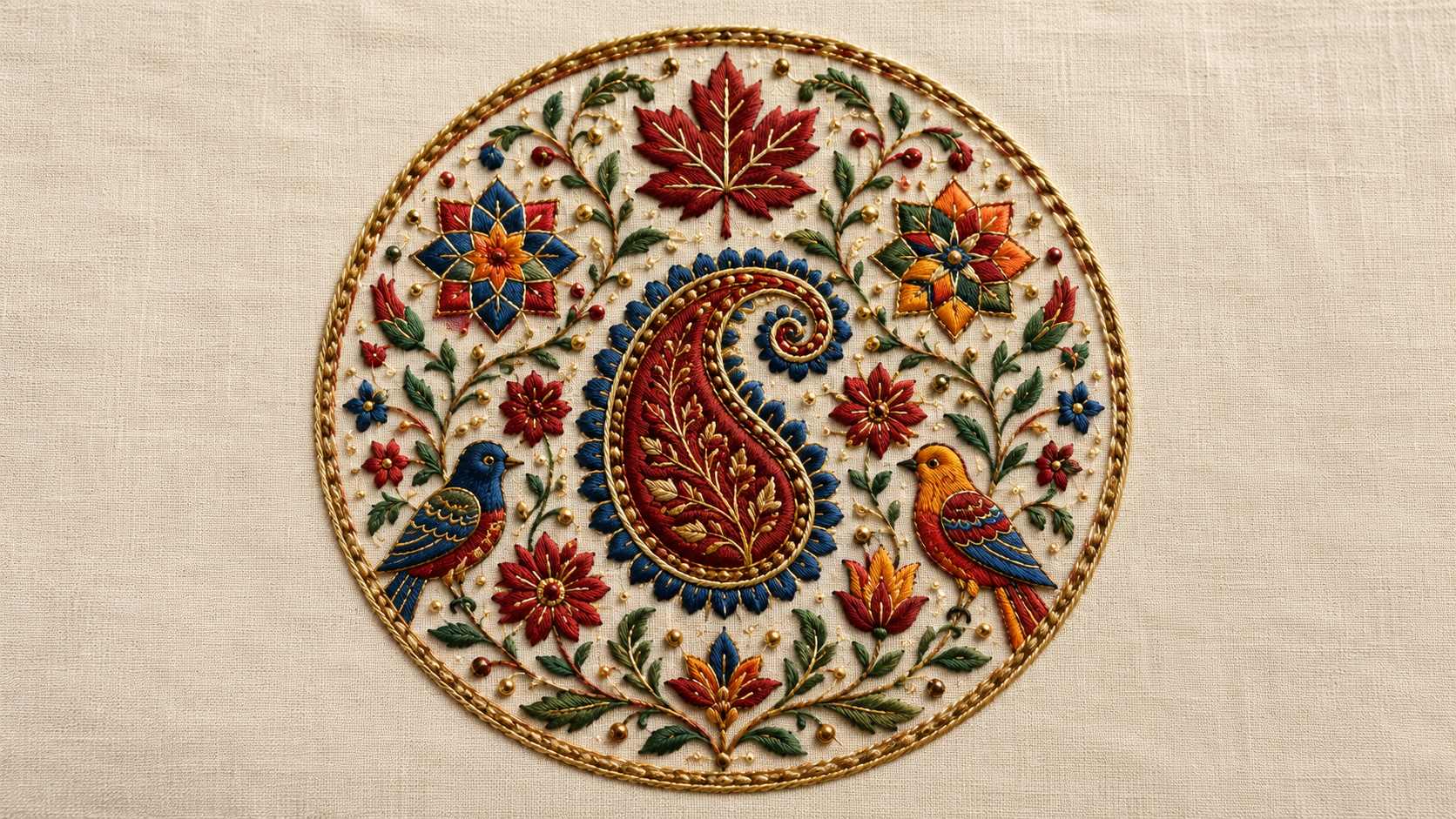
Kashida is the embroidery of Kashmir: chinar leaves, paisleys (ambi), almond blossoms, birds and vines, drawn from the valley's landscape and stitched mostly in stem, chain and satin stitches. Its refined form, sozni, produces astonishingly fine shawl work; tilla adds metallic thread for festive pieces. Kashida relies on a relatively small repertoire of stitches, achieving its detail through flowing lines and colour instead. (It's also the craft that inspired our own name — we've written a full guide to kashida embroidery and its famous motifs.)
6. Aari — the hooked needle that draws in thread
Aari work is defined by its tool: a pen-like hooked awl (the aari, similar to a tambour hook) that loops thread through fabric from above, producing fast, continuous chain stitch. One Kashmiri form of aari work is known as zalakdozi, covering shawls and namdas with flowing vines; in Gujarat and Uttar Pradesh, aari centres produce richly beaded and sequinned work for garments and bridal wear. Because the hook moves quicker than a needle, aari is especially well suited to large, flowing designs with dense coverage.
7. Kasuti — Karnataka's counted-thread geometry
Kasuti, from the Dharwad region of Karnataka, is precision embroidery: motifs are built by counting the threads of the fabric, without any drawing on the cloth. Its four traditional stitches — gavanti (double running), murgi (zigzag), negi (a running/darning stitch that produces a woven effect) and menthi (cross stitch) — create temple towers (gopura), chariots, lamps, peacocks and lotuses, classically on dark handloom saris like the Ilkal. Fine kasuti in gavanti stitch looks identical on both sides of the cloth — a mark of mastery.
8. Toda embroidery — the Nilgiris' red and black
The Toda people of the Nilgiri hills in Tamil Nadu embroider pukhoor — bold red and black geometric bands on white cotton — for their distinctive shawls (putukuli). Worked by counting threads in a reverse-darning technique, the embroidery is dense and slightly raised, and the finished work is so neat it appears nearly identical on both sides. Toda Embroidery holds a Geographical Indication (GI) registration and remains a living tribal craft practised by Toda women.
9. Banjara / Lambani — embroidery that jingles
The Banjara (Lambani) communities of Karnataka, Telangana and Andhra Pradesh make India's most exuberant embroidery: brilliant threadwork combined with mirrors, cowrie shells, coins, tassels and patchwork on cotton bases. Traditionally stitched for their own dress — skirts, blouses, bags — Banjara work is now prized by designers worldwide for its bold, maximalist energy. Sandur Lambani embroidery from Karnataka holds a GI tag.
10. Shisha — the art of stitching mirrors
Shisha (mirror work) embeds small mirrors into fabric, held not by glue but by a lattice of foundation threads locked with buttonhole-style stitches around the rim. Strongly associated with Gujarat and Rajasthan, mirror work flashes light with every movement — which is exactly the point. It rarely travels alone: you'll find shisha sparkling inside Kutch embroidery, Banjara work and Rajasthani torans and ghagras.
11. Kutch embroidery — a district of many hands
"Kutch embroidery" is really a family of related embroidery traditions from the pastoral communities of Kutch, Gujarat — Rabari, Ahir, Mutwa, Jat and others — each with its own identity: some dense with mirrors, some built on tiny square chain stitches, some (like suf) counted from the reverse in precise triangles. What unites them is intensity: silk floss packed tight on cotton, colour on colour. Kutch embroidery holds a GI tag, and authentic pieces are still stitched within these communities.
12. Chamba Rumal — needle paintings of Himachal
The Chamba Rumal of Himachal Pradesh turns embroidery into miniature painting: scenes from Krishna's life and pahari court art, stitched in untwisted silk using a double satin stitch (dorukha) that renders the image identically on both faces of the cloth. Traditionally embroidered on square rumals (coverings) exchanged in weddings, the craft is closely tied to the Pahari miniature painting tradition and carries a GI tag.
13. Gota Patti — Rajasthan's ribbon shine (an honest note)
Gota patti, the festive shine of Rajasthan, is technically appliqué rather than embroidery: strips and shapes of gold or silver gota ribbon are folded and stitched onto fabric to build flowers, leaves and borders. We include it because no list of Indian textile surface work feels complete without it — and because it shows how wide the craft spectrum runs, from a single white thread in Lucknow to gleaming ribbon in Jaipur.
Hand crafts and modern embroidery — where each belongs
Every craft above is a hand tradition, kept alive by artisan communities — and if you want authentic chikankari, phulkari or kutch work, the right thing to do is buy it from those artisans and pay fairly for it. Modern custom embroidery is a different tool for a different job: precise, durable, repeatable stitching for logos, monograms, names and patches on garments that live in the real world — office polos, caps, T-shirts, uniforms. The two aren't rivals; they solve different problems. A bridal lehenga deserves zardozi hands. A 200-piece staff uniform order, a personalised cap, or a jacket patch deserves clean, precise embroidery that survives a hundred washes.
At Kashidha Designs we work squarely in the second world: premium custom embroidery, made to order — embroidered T-shirts, caps, patches and badges, monograms and logo work — often drawing on the motif vocabulary these hand traditions perfected. Our name itself honours one of them: kashida, the embroidery of Kashmir.
Frequently asked questions
How many types of embroidery are there in India?
There's no authoritative count — textile references commonly describe somewhere between 15 and 25 major regional traditions, from chikankari and zardozi to kasuti and kantha, with many local variations inside each. This guide covers the thirteen most celebrated.
Which Indian state is famous for which embroidery?
Uttar Pradesh (Lucknow) for chikankari, Punjab for phulkari, Bengal for kantha, Kashmir for kashida and sozni, Karnataka for kasuti, Gujarat for kutch and mirror work, Tamil Nadu's Nilgiris for Toda work, Himachal for the Chamba Rumal, and Rajasthan for gota patti. Zardozi has several historic centres — Lucknow, Bhopal, Delhi, Agra, Banaras and Hyderabad among them.
What is the oldest embroidery tradition in India?
Embroidery in the subcontinent is ancient — needlework is referenced in early texts and depicted in classical art — but reliable dating of individual styles is difficult. Many of today's famous traditions acquired the forms familiar to us between the medieval and early modern periods, with Mughal influence shaping some of them.
What is the difference between hand and modern embroidery?
Hand embroidery is stitched by artisans with needle (or hook) and thread — slow, expressive, and unique piece to piece. Modern custom embroidery is digitised and stitched for speed and consistency — fast, precise, and identical across a batch, which makes it right for logos, uniforms, names and patches.
Which embroidery styles have GI (Geographical Indication) tags?
Several Indian embroideries are GI-protected, including Lucknow Chikan Craft, Kutch Embroidery, Toda Embroidery, Sandur Lambani Embroidery and the Chamba Rumal, among others. A GI tag ties the authentic craft to its region and community.
Can traditional motifs be recreated in modern embroidery?
The motifs, yes — paisleys, chinar leaves, phulkari-style geometry and kasuti-style patterns digitise beautifully. The result is modern embroidery inspired by a tradition, not the hand craft itself — a distinction an honest studio will always make clear.
Thirteen traditions, one needle's promise
From a white thread whispering across Lucknow muslin to mirrors flashing on a Banjara skirt, Indian embroidery is less a single craft than a continent of them. Knowing the names is the first step to valuing the hands behind them. And when your own project calls for stitched-not-printed permanence — a logo, a name, a patch, a gift — that's the world we live in every day. Explore our design library or see how we bring thread to fabric at Kashidha Designs.
Written by
Kashidha Designs
Related Articles