Kashida Embroidery Designs: Famous Motifs & Patterns Explained
Kashidha Designs
July 27, 2026
Search for "kashida designs" and you'll find everything except a clear answer. So here it is: kashida designs are the nature-inspired motifs of Kashmiri kashida embroidery — chinar leaves, paisleys, blossoms, birds and vines, drawn from the valley's landscape and stitched into fabric for centuries. This guide walks through the famous motifs one by one: what each looks like, what it means, and how these classic patterns translate into modern embroidery today.
What makes a kashida design recognisable
Three things set kashida designs apart from other Indian embroidery traditions:
- Nature predominates. Kashida draws predominantly from the Kashmir valley — its leaves, flowers, birds and orchards. Nature motifs overwhelmingly dominate, while human figures and geometric or narrative themes (such as Shikargah hunting scenes, mostly seen on fine Kashmiri shawls) are comparatively uncommon; the craft is largely a landscape rendered in thread.
- Economy of stitches. Traditional kashida achieves its detail with remarkably few stitch types — primarily stem, chain, satin and darning stitches, with regional variations — relying on flowing lines and colour rather than technical variety.
- Flow over symmetry. Motifs trail, climb and scatter the way vines actually grow. A kashida design breathes; it is composed but never rigid.
The famous kashida motifs, explained
1. Chinar leaf
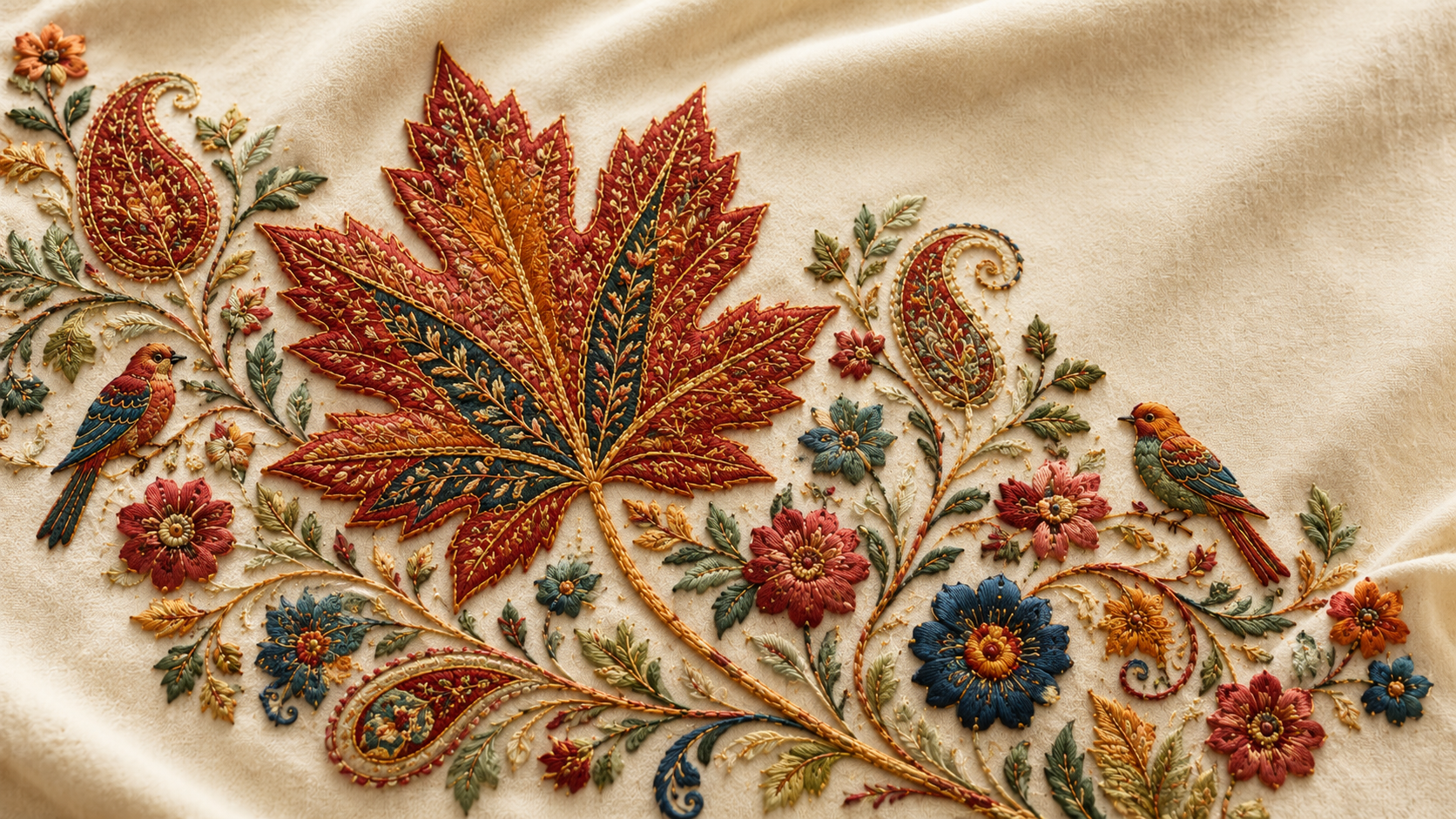
The five-pointed leaf of the Oriental plane tree is the unofficial emblem of Kashmir itself, and the most beloved kashida motif. In autumn the chinar turns crimson and gold, and embroiderers mirror that: chinar-leaf designs are typically worked in flame colours — rust, amber, deep red — with the veins picked out in stem stitch. A single well-stitched chinar leaf can carry an entire piece.
2. Paisley (Ambi / Badam)
The teardrop-with-a-curl that the world calls paisley was popularised worldwide through Kashmiri shawls, where it is commonly called ambi or badam (almond). In kashida it appears everywhere — as a single bold statement, in trailing borders, or packed into dense all-over patterns. The classic treatment fills the interior with tiny florals and finishes the outline in a contrasting colour.
3. Blossoms and flowering vines (Posh)
Posh means flower, and flowering vines are kashida's connective tissue — almond blossom, cherry blossom, iris, lotus and saffron crocus, linked by curling stems. Vine designs are the natural choice for borders, sleeves, necklines and frame edges, because they can run to any length without repeating awkwardly.
4. Birds of the valley
Kingfishers, parrots, magpies and the occasional peacock perch among kashida's vines. Bird motifs are usually small and lively rather than grand — a flash of blue-green thread between flowers. They add movement to a composition and are traditionally considered auspicious.
5. Grapes and orchard fruit
Kashmir's orchards supply the grape motif — tight clusters of round berries with broad leaves — along with cherries, plums and almonds. Fruit motifs are often filled with satin or closely packed stitches for a raised, glossy finish and often anchor the corners of a design.
6. The almond and the tree of life
Larger compositions arrange the individual motifs into a tree of life — a central flowering trunk spreading across the whole panel, with birds and blossoms in its branches. This is kashida at its most ambitious, often seen on larger shawls and decorative wall pieces meant to be admired flat.
The kashida colour palette
Traditional kashida is stitched tone-on-tone or in a restrained palette drawn from the same landscape as its motifs: crimson and gold for autumn chinar, sage and emerald for spring vines, ivory and ochre on natural wool grounds. The base fabric matters as much as the thread — the classic grounds are white, cream and other subdued colours, letting the motif carry the colour. If you're choosing a palette for a kashida-inspired piece today, the safest rule is the traditional one: one ground, two or three thread colours, one of them doing most of the work.
Kashida designs on modern pieces
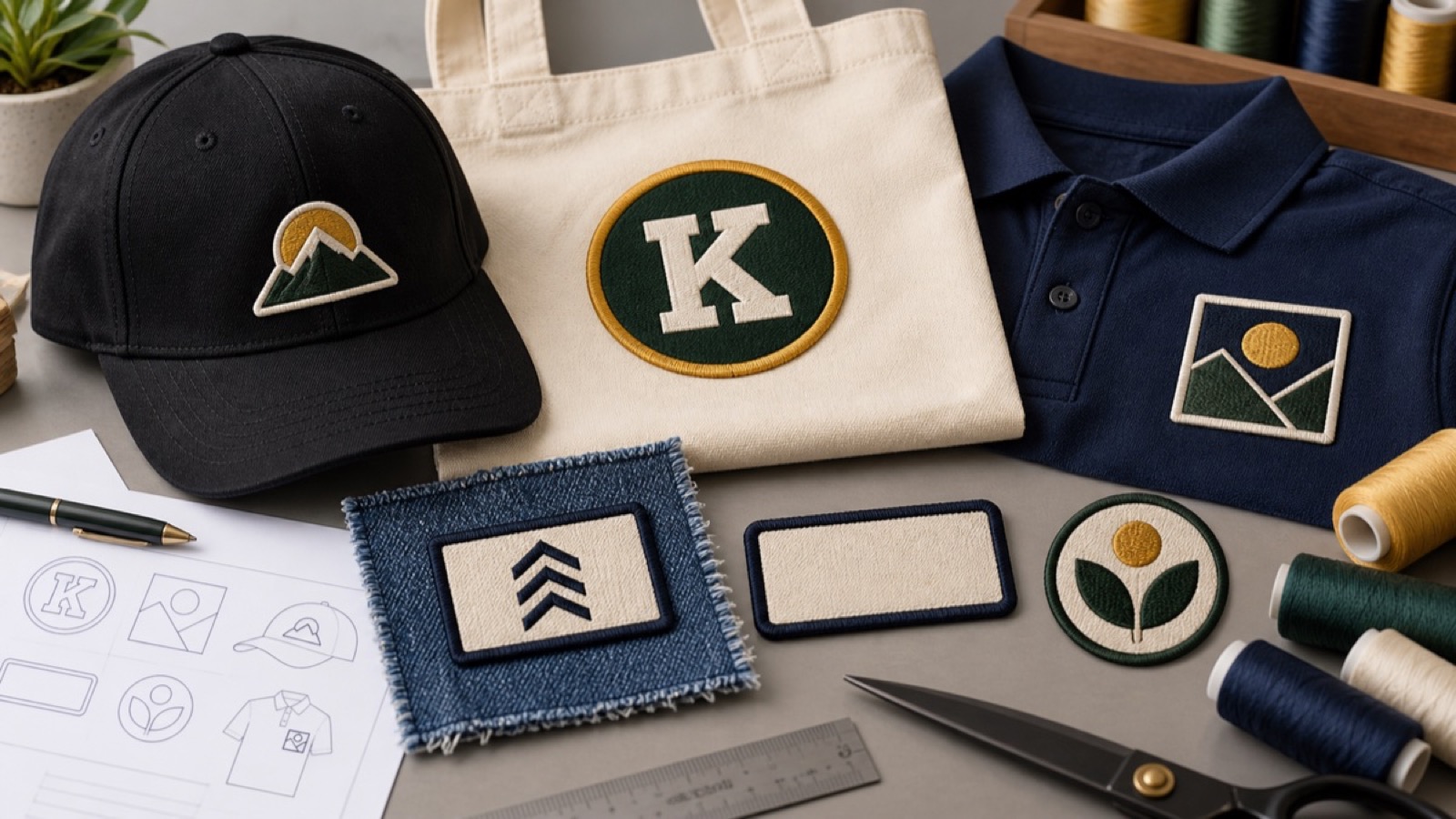
The reason these motifs have survived for centuries is that they translate. A single chinar leaf sits as naturally on a cap's front panel as it once did on a pashmina. A paisley reads beautifully at chest-logo scale. A blossom vine wraps a glass frame the way it once wrapped a shawl border. Modern custom embroidery renders these motifs in polyester thread with a precision suited to modern apparel and repeated laundering — the same designs, built for daily wear and washing.
A note of honesty, because this craft deserves it: modern kashida-inspired embroidery is an interpretation, not the authentic hand craft. Authentic kashidakari is stitched by hand by Kashmiri artisans, and if that's what you're seeking, buy it from them — it is worth every rupee. What modern embroidery offers is the motif vocabulary — the chinar, the ambi, the vine — made practical for T-shirts, caps, patches and framed pieces that live outside the display cabinet. (We've written about this distinction at length in our complete guide to kashida embroidery.)
How to choose a kashida design for your piece
- Match the motif to the space. Single motifs (chinar, paisley) suit small placements — chest, cap front, patch. Vines suit edges and borders. Tree-of-life compositions need a full panel — a frame or a back print area.
- Respect the palette. Two or three thread colours on a plain ground will always look more authentically kashida than a rainbow.
- Let the line flow. If you're adapting or commissioning a design, keep the stems curved and continuous — straightened, gridded kashida stops looking like kashida.
- Scale the detail honestly. Fine interior detail disappears below about 6 cm; at small sizes, choose motifs with bold silhouettes.
Frequently asked questions
What are kashida designs?
Kashida designs are the traditional motifs of Kashmiri kashida embroidery — principally the chinar leaf, paisley (ambi), flowering vines, birds, and orchard fruits — stitched in stem, chain and satin stitches, almost always inspired by the Kashmir valley's natural landscape.
Which kashida motif is the most famous?
The chinar leaf and the paisley are the two signature motifs. The chinar is Kashmir's own emblem; the paisley, popularised worldwide through Kashmiri shawls, went on to become one of the most reproduced patterns in world textile history.
What is the difference between kashida and kashidakari?
They refer to the same craft — kashida is the embroidery style, kashidakari literally means "the work of kashida." Both describe Kashmiri needlework built on nature motifs.
Can kashida designs be recreated in modern embroidery?
The motifs, yes — chinar leaves, paisleys and vines digitise beautifully and stitch crisply in modern polyester threads. The result is a kashida-inspired design, not authentic hand kashidakari; a good studio will always be clear about that difference.
Which fabrics suit kashida designs best?
Traditionally wool, pashmina and cotton grounds. In modern application the motifs work on nearly any stable fabric — cotton T-shirts, pique polos, twill caps and linen frame panels all take the designs well.
Are kashida designs only for clothing?
No — historically they adorned shawls, namdas (felted rugs) and household textiles. Today the same motifs appear on framed wall art, caps, patches and personalised gifts.
The motifs are the heritage
Kashida's genius was never a secret stitch — it was a way of seeing: take the valley around you and write it in thread. That's why a chinar leaf on a modern cap still reads instantly as kashida, centuries after artisans first stitched it onto Kashmiri textiles. If you'd like to see how these motifs translate into thread today, browse our design library or explore personalised embroidered pieces — and for the full story of the craft, its history and its stitches, read our complete kashida embroidery guide.
Written by
Kashidha Designs
Related Articles